
Showcase
Most tools show you a screenshot of a clean report on a hello-world page. This page is the opposite: it is built to be hard to audit. A WebGL scene, iframes from three hosts, video with captions, art-directed images in three formats and a table that does not exist until a script writes it. Eight site generators build it, from VitePress to mdBook to a client-rendered Angular app, and vidimus audits every one of them on every push to main. Then it runs again, live, in your browser, on the page you are reading.
Audit this page, live
No recording, no screenshot. Press the button and a pocket edition of vidimus runs inside this tab: nine of its checks, rewritten to read this page's DOM and the browser's Performance API as they are right now. It fetches every internal link on the page to see if it is broken, lists every host your browser has talked to, weighs every file it downloaded and looks for anything sticking out of the viewport.
$ vidimus --live
Waiting for you. Whatever it prints is what this page really has, theme and all.
Try to make it complain:
- Scroll down to the OpenStreetMap iframe under Embeds and run it again. The map is lazy-loaded, so
privacyfails as soon as the browser fetches it. The full audit reports the same iframe, and this site accepts it on purpose. - Play the zoo video, then run it again.
privacycatchesyoutube-nocookie.comthe moment the facade lets it in, and not a moment before. - Shrink the window to phone width and run it again:
r12smeasures the page at whatever size it is. - Open this page in another flavor and compare. Each theme brings its own markup, scripts and weight, and the live audit reads all of it.
The real vidimus does much more than this: it serves the build, drives headless Chromium over every page, and runs axe-core, html-validate, Lighthouse and pixel diffs across every page and viewport. The live audit is a taste of it, running where there is no server and no Node.js.
A three.js scene
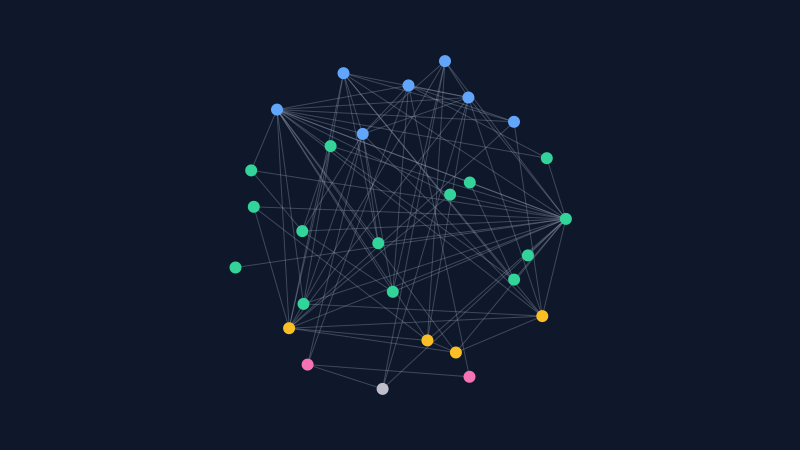
graph.glb when the docs are built.The scene loads three.js from this site, bundled with the page's own script, not from a CDN. It reads its model from a .glb file, spins only while it is on screen, renders a single frame under prefers-reduced-motion: reduce, and leaves the static SVG poster in place when WebGL is not available. The whole block is one role="img" with a text alternative, and the script is an external module, so a strict CSP needs script-src 'self' and nothing else.
What vidimus reports here:
budgetmeasures what the browser fetched, becauserender.includecovers this page: the three.js bundle is the heaviest file.✖ page 521 kB total > 300 kB budget 144 kB /showcase/showcase.js 84 kB /assets/inter-roman-symbols.CQZtw9ew.woff2 80 kB /assets/inter-italic-latin.Duvr4T3O.woff2That is with the page budget lowered to 300 kB to make it speak; the default is 2 MB.
shotsfreezes the scene:requestAnimationFramestops after 30 frames of a virtual clock, so two runs capture the same frame.hugo_showcase@375x800.png unchanged react_showcase@1280x800.png 0.01% changed -> diff/react_showcase@1280x800.pnglighthousescores this page lower than the text pages, 76 to 97 on performance depending on the flavor, so it has its own threshold indocs/vidimus.config.ts:overrides: [{ match: 'showcase', thresholds: { performance: 0.75 } }].csp, on the flavors with a strict meta CSP, finds nothing: the page's policy allowsscript-src 'self'and the script is a file.
Embeds
April 23, 2005: nineteen seconds of Jawed Karim in front of the elephants at the San Diego Zoo, the first video ever uploaded to YouTube. Here it sits behind a click-to-load facade: until you press play, the page shows a thumbnail served from this site and loads nothing from YouTube.
An OpenStreetMap iframe, loaded lazily with a sandbox and no facade, so it is exactly the kind of embed privacy exists to find:
View the map on openstreetmap.org.
A StackBlitz project, behind a facade too: it boots a whole development environment in the browser.
What vidimus reports here:
privacysees no request to YouTube or StackBlitz: the facades load nothing until clicked. The map is reported, with the requests the iframe makes from inside:✖ third-party embed from www.openstreetmap.org loaded in an <iframe> on page load https://www.openstreetmap.org/export/embed.html?bbox=11.2400%2C43.7630%2C11.2700%2C43.7800&layer=mapnik https://www.openstreetmap.org/assets/embed-8cbd447f….css https://www.openstreetmap.org/assets/embed-3c62483a….js on: /angular/showcase /astro/showcase/ /eleventy/showcase/ +5 more → Put the embed behind a click-to-load facade (a static preview that loads the iframe on click), or load it only after consent.It is accepted by an
ignorerule scoped to this page, with a comment saying why.cspchecks the iframe against each page'sframe-src; the Hugo, Eleventy, Zola, React and Angular policies listhttps://www.openstreetmap.org, so it passes, and thesandboxattribute keeps the third-party iframe warning away.shotsmasks the map, a cross-origin iframe, as a black box, so tiles loading in a different order never count as a change.a11yandhtmlrequire thetitleon the iframe.
Video, images and a diagram
A self-hosted video with a poster and captions:
Vidimus is Latin for “we have seen”, so here is someone who has seen everything: a responsive image in AVIF, WebP and JPEG, each at two widths, and the browser picks one.




An inline SVG diagram of a run:
What vidimus reports here:
budgetchecks the image budget and legacy formats: every<picture>has AVIF and WebP sources, so the JPEG fallbacks are not reported, and every<img>haswidthandheight.shotscaptures the page at 375 and 1280 px wide, so the square crop of the tiger and the whole painting each have a baseline of their own.shotsalso pauses the video on its first frame and loads its metadata, so the controls look the same in every run. It waits for lazy images, which it switches to eager loading.- The captions are a
.vttfile, which the built-in server sends astext/vtt, as a host would.
A table filled by a script
The rows below are not in the HTML file: a script fetches them from results.json and adds them. They are a summary of the audit run over these docs, and so are these numbers:
- pages audited
- 217
- links followed
- 650
- audits run
- 11
- audits passed
- 11
| Audit | Status | Summary |
|---|---|---|
| The results are filled in by JavaScript. | ||
What vidimus reports here:
- The table's rows exist only in the rendered DOM.
render.includerenders this page in every flavor, sohtmlvalidates the rows andseoandassetsread the page as a browser sees it. Without it they would read the empty<tbody>of the built file. - In the React and Angular flavors every page is like this table: the built file is an empty shell, and the page exists only after the app runs. See Client-rendered apps.